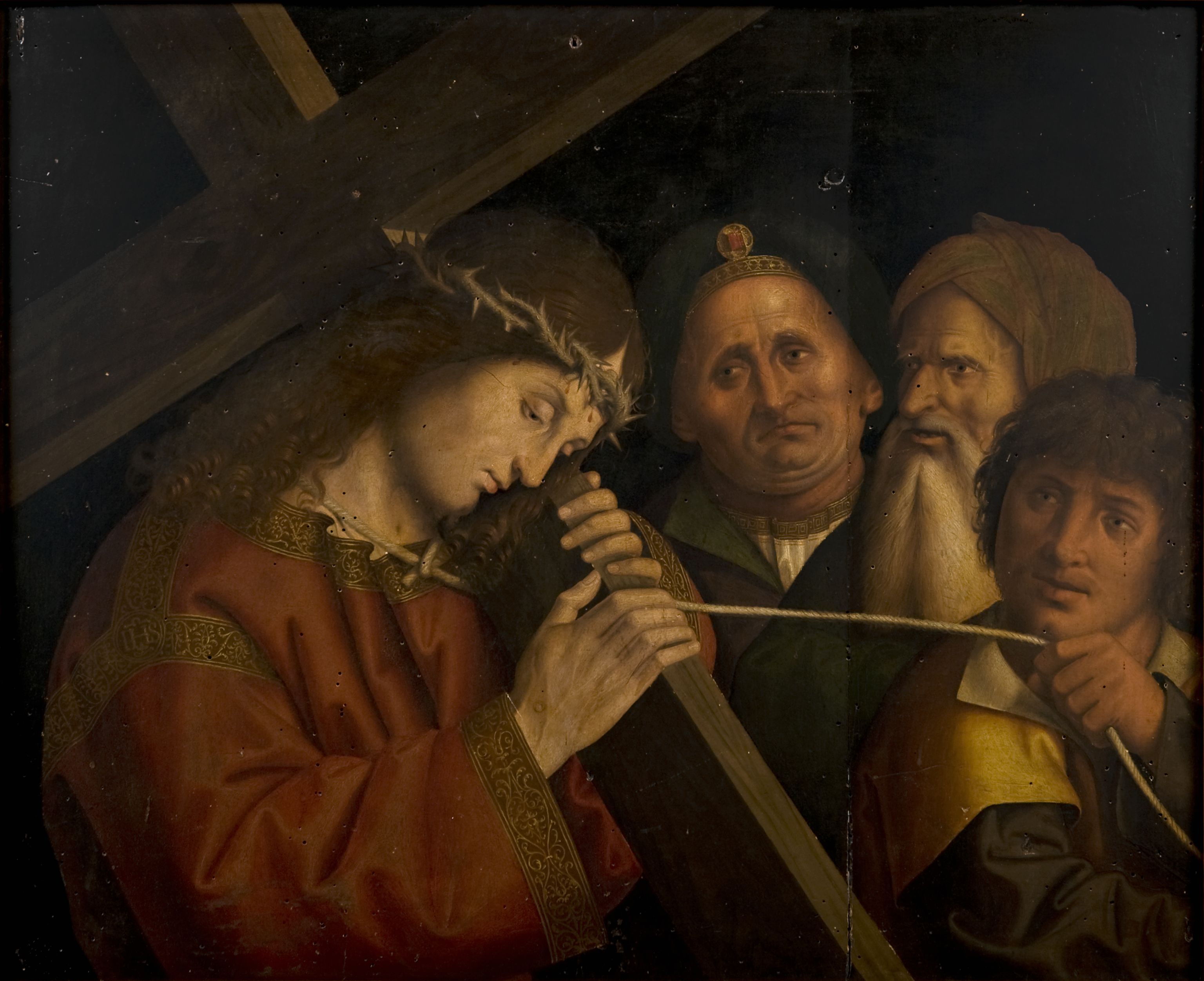
Four figures in a half-bust pose stand out against a black ground. In the foreground on the left, wearing a purple-red tunic trimmed with gold, Jesus is portrayed in one of the most dramatic moments of his Passion, the journey to Calvary. He wears the crown of thorns on his head and his heavy cross weighs down on his left shoulder. A jailer, on the right, is leading him to his place of execution, pulling on the end of a rope tied around his neck. Behind them, two figures watch the scene, one sporting a thick white beard and wearing a turban, the other, nobly clad, wearing a compassionate look on his face.
Paintings of this kind, rich in pathos, were not uncommon in the Renaissance and were designed for private devotion. The image of Christ, suffering and humiliated, as he makes his way towards the place of his sacrifice was intended to arouse the emotions of the faithful and to stimulate personal meditation.
The iconography of Christ Carrying the Cross enjoyed widespread popularity in the Veneto, Lombardy and Romagna in the late 15th and early 16th centuries, due, in the view of certain scholars, to the presence of an illustrious prototype, possibly by Giovanni Bellni (Viroli 1991). Artists such as Giovanni Francesco Maineri (Modena, Galleria Estense, inv. no. 4165), Francesco Zaganelli (Modena, Galleria Estense, inv. no. 3476) and Girolamo Marchesi da Cotignola (Rome, Galleria Spada, inv. no. 63) all turned their hand to the theme, while we know of roughly twenty paintings on the theme by Marco Palmezzano and his workshop. Angelo Mazza (2001) has divided this group into three categories on the basis of their compositional features. A first group shows the solitary figure of the Saviour carrying the cross, a second shows him in the company of his jailer, while a third group develops a horizontal composition with four figures: Christ, the jailer and two onlookers in the middle ground, possibly Nicodemus and Joseph of Arimathea (Mazza 2001, p. 14). The Faenza painting clearly belongs to this latter group, yet unlike the versions in the Museo Correr in Venice (inv. no. 52, signed and dated 1525) and in the Pinacoteca di Forlì (inv. no. 75, signed and dated 1535), the scene in this case is a mirror image – a fact which may be explained by the artist’s use of a cartoon in reverse. Moreover, unlike the picture in Forlì, the Faenza painting has a dark background rather than an airy landscape, nor can we see the hands of the bearded figure in the middle ground.
The provenance of this image of Christ Carrying the Cross is unknown (Casadei 1991). In the Pinacoteca’s earliest catalogue, Argnani (1881, pp. 18-19) was the first to reject its traditional, yet erroneous, attribution to Giovanni Bellini, putting forward the name of Palmezzano instead. His suggestion was subsequently accepted by Grigioni (1956, pp. 124, 630) and has never been questioned since by scholars who have always emphasised the superb quality of the painting, Anna Colombi Ferretti even calling it “one of the finest versions of the theme ever painted by this artist” (2015, p. 25).
The soft brushwork with which the warm palette is applied testifies to the influence of Venetian painting (and of Giovanni Bellini and his workshop in particular) on Palmezzano, who is known to have spent time in Venice in 1495. At the same time, his choice of a dark ground imbuing the scene with strong pathos and the jailer’s grotesque expression in contrast with the impassive beauty of Christ’s face (as remarked by Mazza 2001, p. 16) are clearly of northern European inspiration. The painter may have been familiar with examples of German art through the circulation of prints of a devotional nature, but we cannot rule out the possibility that he may have been able to observe a number of original works at first hand while in Venice, a city that enjoyed a thriving trade with northern Europe in his day (ibid.).