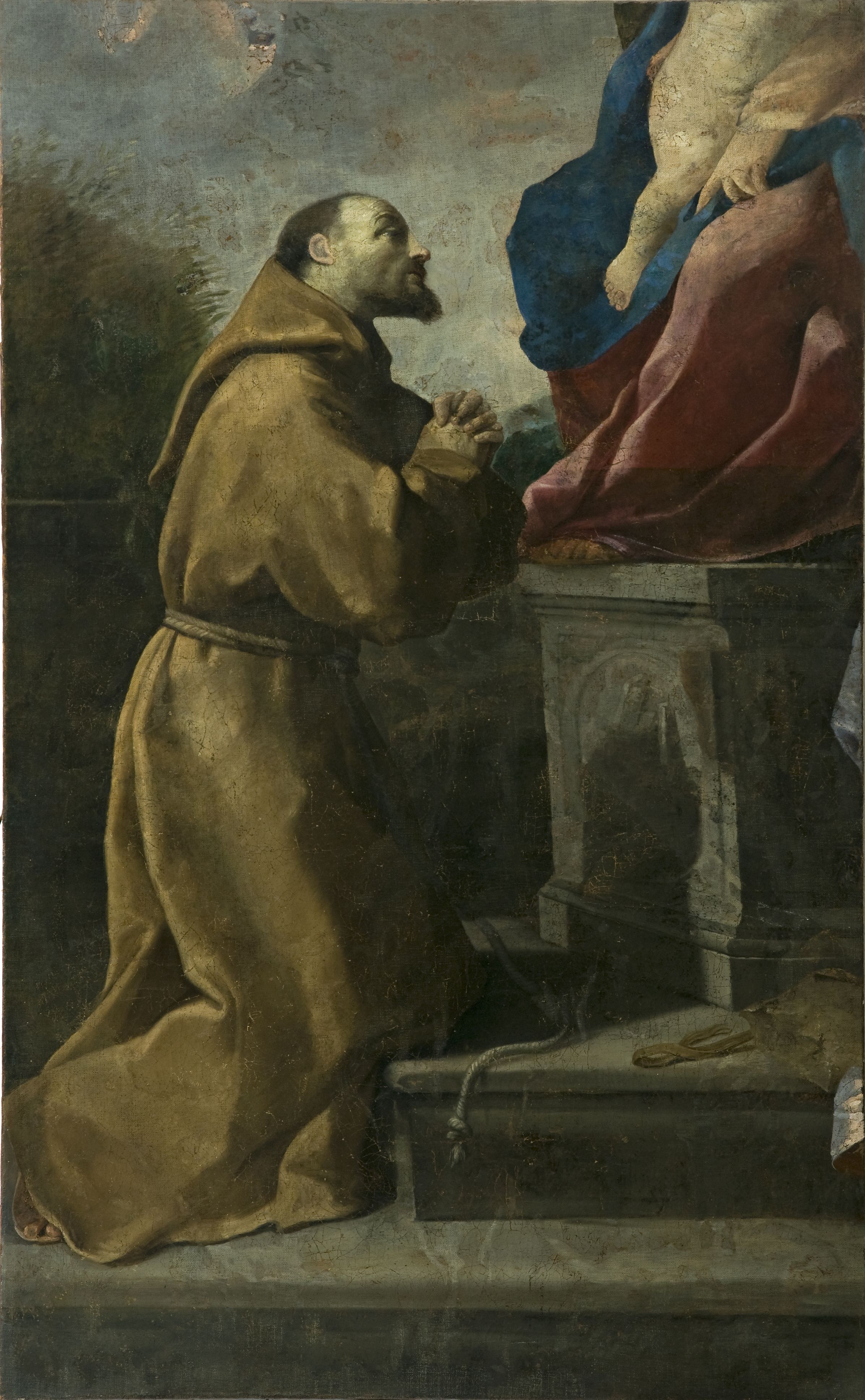
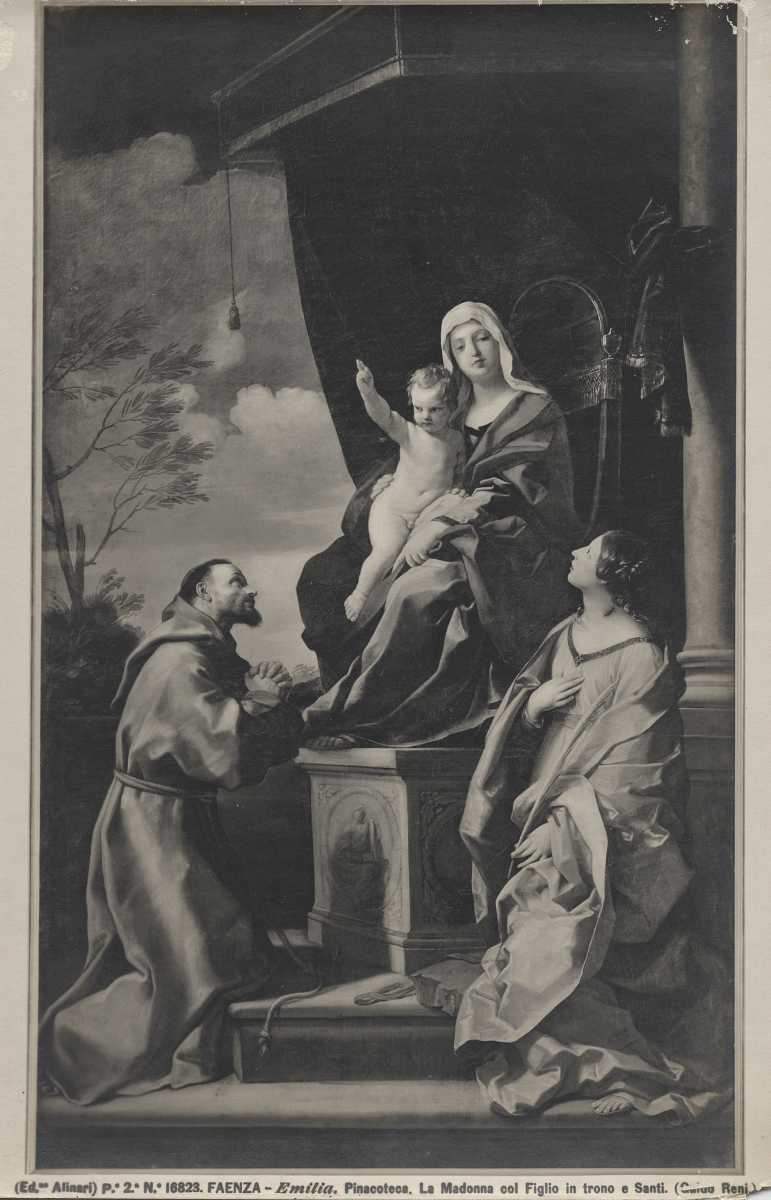
The altarpiece painted by Guido Reni depicting the Virgin Enthroned with St. Francis and St. Christina (Fig. 1) for the church of the Capuchin friars’ convent in Faenza and of which only a fragment, now in the local Pinacoteca Comunale, has survived, had an extraordinarily troubled history.
First of all, despite a mention in Scannelli’s Microcosmo della pittura published in 1657, it is missing from the list compiled by Carlo Cesare Malvasia, the most important Bolognese historian, connoisseur and commentator of the “divine” Guido, as Reni was known even in his own lifetime. This serious and inexplicable omission is remedied only in part by Giampietro Zanotti’s inclusion of the picture in his revised edition (1841) of Malvasia’s Felsina Pittrice, Vite de’ Pittori Bolognesi published in 1678, in which Zanotti reports the praised lavished on the altarpiece by the scholar Francesco Algarotti in 1762:
«The composition of the picture – Algarotti writes – clearly shows the extent to which he had his favourite, Paolo, in mind, while his handling of drapery reveals the degree to which he studied the work of Alberto Durero […]». Morever, Algarotti adds, «Vandike never painted a truer nor a more diaphanous head of flesh. Nor could the rapture with which the saint prays have been better captured or conveyed by Domenichino himself» (in Bottari, Ticozzi, 1822)
The “Paolo” to whom Algarotti refers is the celebrated painter Paolo Caliari known as Veronese (Verona 1528 – Venice 1588), whose work Reni unquestionably studied in his formative years, just as he must have looked to the prints of “Alberto Durero” (Albrecht Dürer, Nuremberg 1471 – 1528). By the same token, Guido’s work attracted the attention both of “Vandike” (Antoon van Dyck, Antwerp 1599 – London 1641) and, of course, of “Domenichino” (Domenico Zampieri, Bologna 1581 – Naples 1641), his contemporary and a pupil and assistant of Annibale Carracci in Rome.
Several years later, possibly thanks in part to the praise lavished on it by Algarotti, the majestic altarpiece (which originally stood almost four metres high, exactly 363 x 219 cm.) did not escape the eagle eye of the commissioners travelling in the wake of the victorious French Army, who had been tasked by Napoleon with choosing the most important works of art in the lands his troops had conquered to enrich the collections in the Louvre. The picture returned from Paris in 1817 and was restored with some difficulty to its original setting in the Capuchin friars’ church, where it remained for only a few decades before being earmarked for the local Pinacoteca in 1867 following the suppression of monasteries after the unification of Italy.
With the outbreak of World War II, followed by the rapid northward advance of the southern front, it was decided to place the altarpiece in a safe haven, only to then move it again on eve of the Allied air raids of 1944 to another location which, in the event, proved far less safe. In the air raids and the fierce fighting on the ground that took place in their wake, virtually obliterating the city of Faenza which had the misfortune to lie just behind the Gothic Line where the Germans were seeking to halt the Allied advance, the altarpiece was blown to pieces and the postwar restorers into whose care it was given could only save a small fragment – the figure of St. Francis from the left-hand side of the picture.
Nor did this mark the end of the painting’s tribulations. In an otherwise meticulous monographic work on Reni published by US art historian Stephen Pepper in 1984, the altarpiece is described as a “Virgin and Child with St. Francis and St. Catherine”, rather than St. Christina as Giampietro Zanotti had correctly intuited in his day, and it is dated c. 1630, in other words at a fairly late date in Reni’s career, when it was in fact painted at least twenty years earlier as we shall see below.
These inaccuracies and oversights were only remedied years later when the altarpiece’s allocation document was discovered in the Capuchin friars’ Libro campione (their main account ledger), telling us that it was commissioned from Reni in 1613 «by order and at the expense of the most illustrious Sig. Vincenzo Serpa, a right noble gentleman of Bologna», «who took the Capuchin cowl» that same year (Biagi Maino 1986).
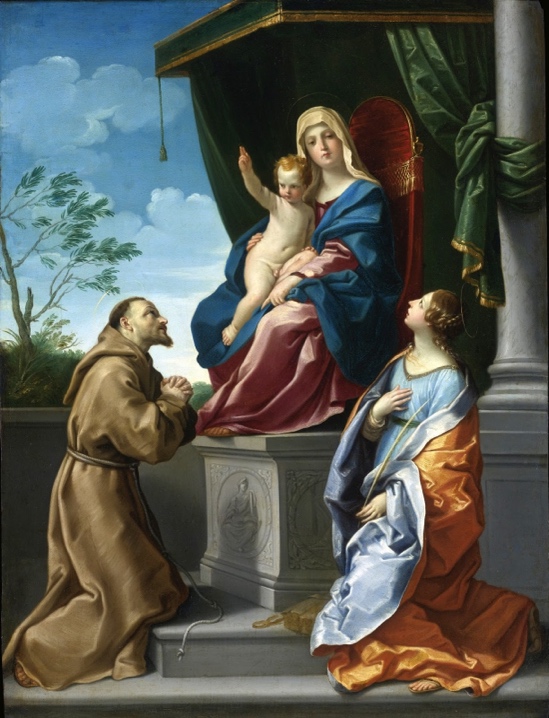
That the altarpiece is a product of Reni’s youth rather than of his maturity may also be confirmed by an examination of a scaled-down “pocket” version which recently appeared on the antique market (New York, Sotheby’s, 29 January 2015, lot 306: fig. 2). The painting in question reproduces the altarpiece on a small copper plate (53.3 x 40.6 cm.) with a number of variations. By comparison with the original altarpiece, the canopy, the cloth wrapped around the column and the branches of the tree behind St. Francis have been lowered and a handful of other minor details have been changed.
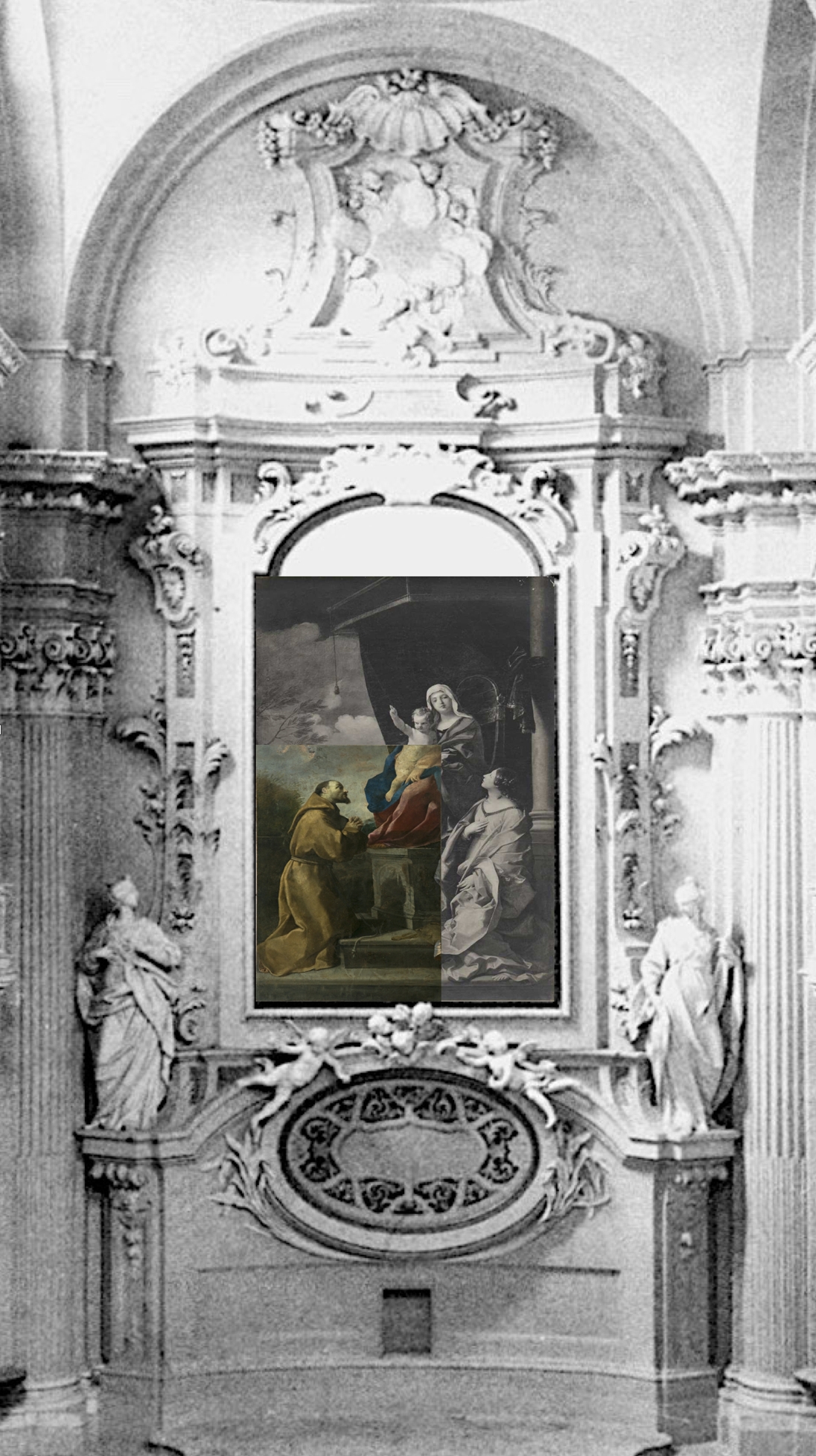
If we digitally insert the Pinacoteca Civica’s surviving fragment into a photograph of the lost altarpiece (fig. 3) set in an imaginary altar (given that the original altar has been totally destroyed), we can form a picture of how the altarpiece must have looked to an 18th century observer such as Francesco Algarotti, thus making it instantly clear why he lavished such endless praise on this youthful masterpiece by Guido Reni of which we now have only a small physical fragment, but a long and detailed history.