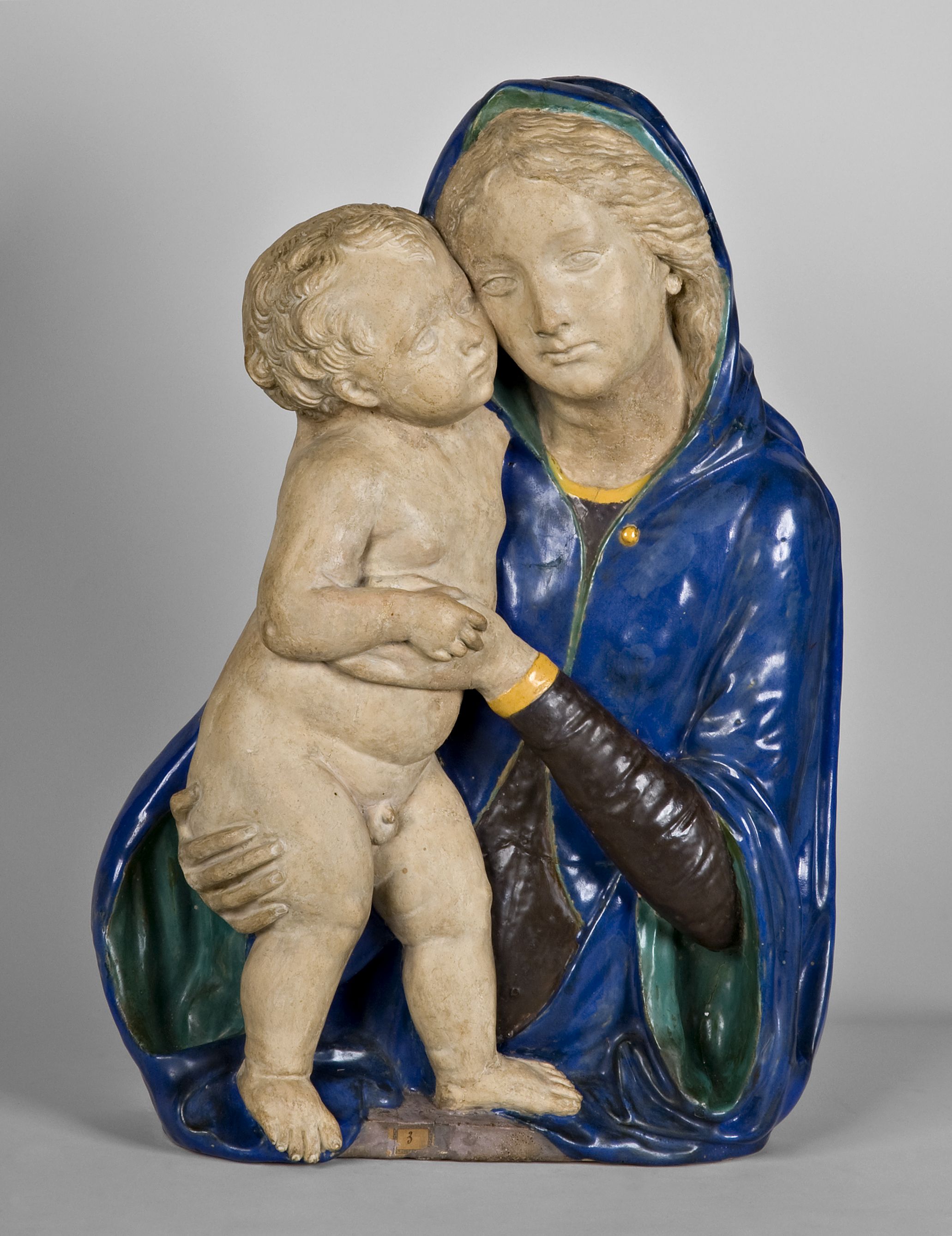
This small terracotta relief depicts, in a three-quarter pose, a young and tender Virgin Mary clasping the Christ Child who stands naked before her. It is one of several surviving examples of a relief produced by the workshop of Andrea della Robbia (Florence, 1435 – 1525). Known as the Via della Scala Madonna, it stands in a roadside tabernacle set into the corner of Bernardino Rucellai’s palazzo (now Palazzo Venturi Ginori) on the corner of Via della Scala and Via degli Orti Oricellari in Florence (Casadei 1991, for the various derivations, of which at least seven are known; see Marquand 1922, from no. 303 to no. 309, pp. 166-170).
These icons of a devotional nature, replicating popular models and designed to hang on palazzo walls, were produced in series using moulds. The composition of the Virgin and Child was conceived on the basis of recurring modules, while the artist creating the individual work could keep, remove or add details as he chose, or even introduce considerable stylistic variations. For example, the button holding the cloak in place or the shape of the sleeves on the robe, which are identical to the original in this piece, are not found in other exemplars. By comparison with the Via della Scala Madonna, however, the Faenza version’s figures rest on a smaller base, while the overall white glaze is reserved here for the Virgin’s tunic tinged with purple and edged in yellow, and for her blue cloak with its green lining. Glazing is the technique with which Luca della Robbia (1399 – 1482) and his nephew Andrea were accustomed to finish the surface of their terracotta works, using white or coloured enamels which underwent a glazing process during firing. Sometimes they would also resort to naturalistic polychromy applied “cold” using oil paints, while in other cases they might combine glazing with oil paints, using the paints to achieve colours that they would find difficult to produce using ceramic enamels, for example the red spectrum or the colour of flesh (M. G. Vaccari, La tecnica della terracotta invetriata. Quando la terra diventa vetro, in G. Gentilini, F. Petrucci, F. Domestici, Della Robbia, Florence 1998, p. 19). In the Faenza terracotta, the parts devoid of enamel (the Virgin’s face and hands, and the Christ Child’s body) were intended to be painted at a later stage, though in the event that stage was never implemented. Equally typical of the Della Robbia workshop, although not adopted here, was the technique of painting the irises in the figures’ eyes. In our case, the irises were simply engraved.
By comparison with the original Della Robbia model, Massimo Ferretti detected a “sharper, livelier” note in the Faenza version, and recalling the existence also of 19th century replicas of the original model, he assigned it to the style of a sculptor working in the early decades of the 16th century, conventionally known as the Master of the Restless Children (Ferretti 2011, p. 29). Of the intense activity of the Della Robbia workshop, in particular of Andrea who was responsible for the widespread dissemination of glazed terracottas throughout the Italian peninsular and other parts of Europe, Faenza has three large coats-of-arms with the devices of the Manfredi family, made for the vaults of the Cathedral, and once had a splendid lunette with St. Michael the Archangel fashioned c. 1475 for the church of San Michele (now in the Metropolitan Museum in New York, inv. no. 60.127.2 ) (for Andrea della Robbia’s work for Faenza, see G. Gentilini, I Della Robbia. La scultura invetriata del Rinascimento, Florence 1992, vol. 1, pp 175-176 and Ferretti 2011, pp. 68-71 and p. 78).