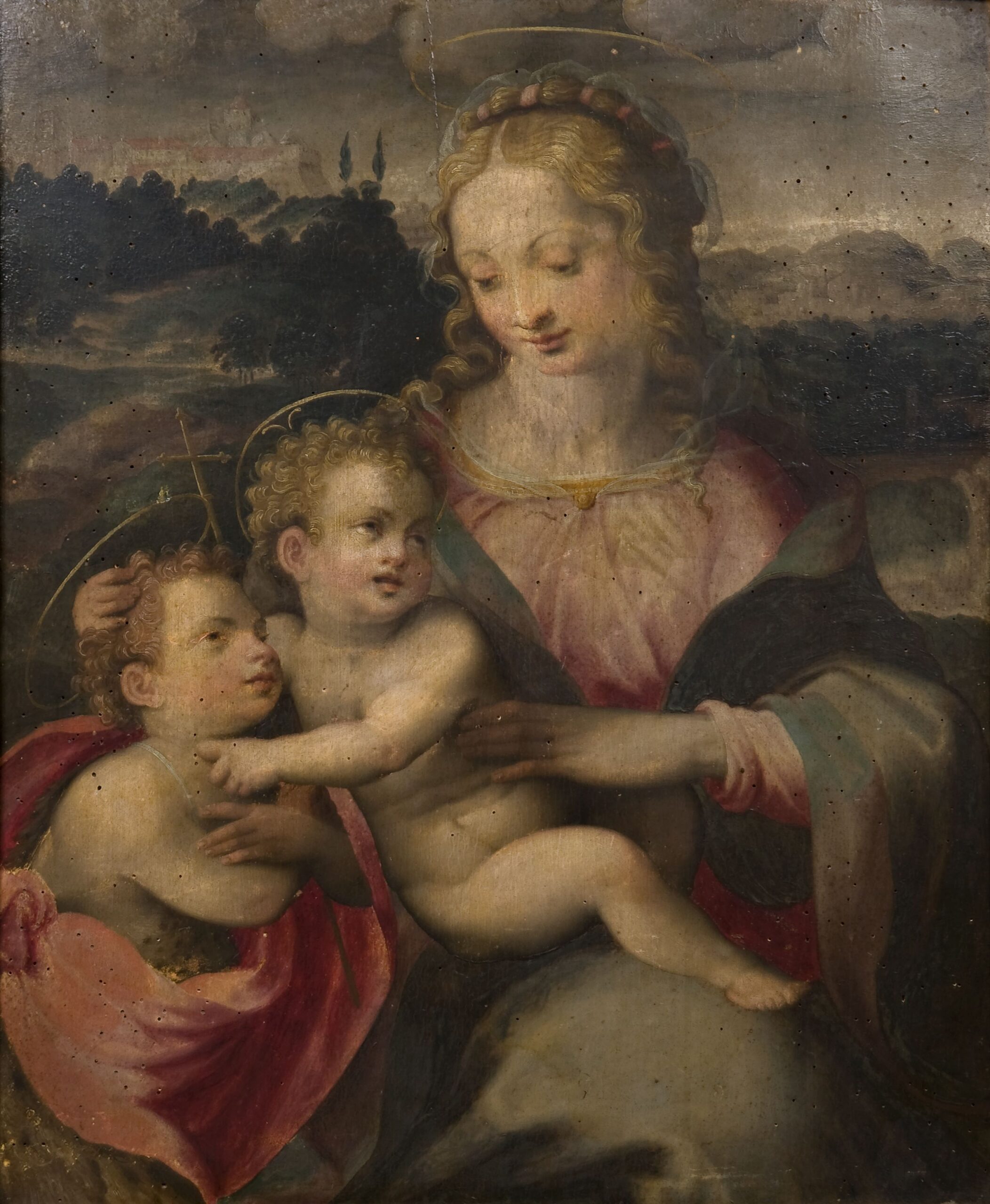
In the second half of the 16th century, Michele Tosini’s workshop – alongside that of Giorgio Vasari – was one of the most prolific and most sought-after workshops in Florence. Tosini was remarkably successful with a very varied clientele, who appreciated his sophisticated work reflecting the second Mannerist style that had taken hold in the city. Among Michele di Ridolfo’s numerous pupils and close followers of his style, the brothers Francesco and Giovanni Brina enjoyed particular distinction. Their workshop, a satellite of their master’s, boasted an equally flourishing trade. Francesco (1529–86) displayed the greater artistic ambition of the two, as we can see in his Adoration of the Shepherds in the church of Santa Felicita in Florence, which reveals a clear interest in the work of Bronzino, yet in general terms he remained fairly loyal to the manner of Michele Tosini, particularly in his paintings for destinations outside the city (The Crucifixion in the Badia di San Fedele in Poppi, or The Annunciation for the monastery of Santa Caterina in Borgo San Lorenzo).
His brother Giovanni (1534–99), who was perhaps less inventive, seems to have specialised in small Madonnas for private devotion, including the one in the Pinacoteca di Faenza illustrated here. We know of an astonishingly large number of replicas of this composition, almost pointing to a form of serial production. Variations are minimal, even in the landscape (with its typical hints of ‘eccentric’ Florentine painting) which is repeated from one picture to the next. To realise this, one has but to observe the numerous versions of the composition, for instance in the Musée des Beaux-Arts in Menton, the Walters Art Museum in Baltimore or the Palais Fesch-Musée des Beaux-Arts in Ajaccio. We find in all of them the same icy, often iridescent palette, while the figures with their wavy hair, their porcelain flesh and their hands with long, slender fingers sit perfectly in the furrow of Michele Tosini. This is hardly surprising if we consider that relations between the Brina brothers and their master were solid and lasting, as we can see in the chapel in Villa Strozzi a Caserotta in San Casciano Val di Pesa, where Michele and Francesco cooperated on the Baptism of Christ (now Ferrara, Pinacoteca Nazionale) while Giovanni was responsible for the fresco decoration. Moreover, this specific model of the Virgin, the Christ Child and the young St. John the Baptist must be based on a creation of Michele Tosini, probably as part of a larger and more complex composition depicting the Holy Family with St. Elisabeth against an architectural backdrop, of which there are many versions. The Brina brothers extracted the central group from Tosini’s design, removed it from its original context and placed it in a landscape setting, thus enabling it to be reproduced in an infinite number of versions for popular devotion.
The motif of the two children embracing harks back to a distant design of Leonardo da Vinci found, for example, in a drawing in Windsor Castle (The Royal Collection) and, more especially, in the St. Anne cartoon now in the National Gallery in London. The oblique depiction of Jesus, emphasising the dynamic nature of the holy image, was later borrowed and strengthened by Raphael both while he was in Florence (Bridgewater Madonna, 1507, Edinburgh, National Gallery of Scotland) and immediately thereafter when he moved to Rome (Colonna Madonna, 1507–8, Berlin, Gemäldegalerie). These experiments were to serve as raw material for the artists of Florentine classicism, particularly for Fra’ Bartolomeo (Cook Madonna, London, Christie’s, 7 July 2009, lot no. 15) and for Ridolfo del Ghirlandaio (Madonna: London, Christie’s, 7 December 2018, lot no. 174) and his circle (Madonna by the Master of the Scandicci Lamentation, Alès, Musée du Colombier). Michele Tosini was, in turn, so close to his own master that he was be better known by the nickname of Michele di Ridolfo del Ghirlandaio. Thus it comes as no surprise to see him carrying on the great classicising tradition of Ridolfo linking the Mannerism of the final decades of the 16th century to the loftiest work of the early part of that century. It was unquestionably this aesthetic in his images – at once reassuring in their iconography and yet brilliantly modern – that ensured the success both of Tosini and of the Brina brothers, his most loyal followers.