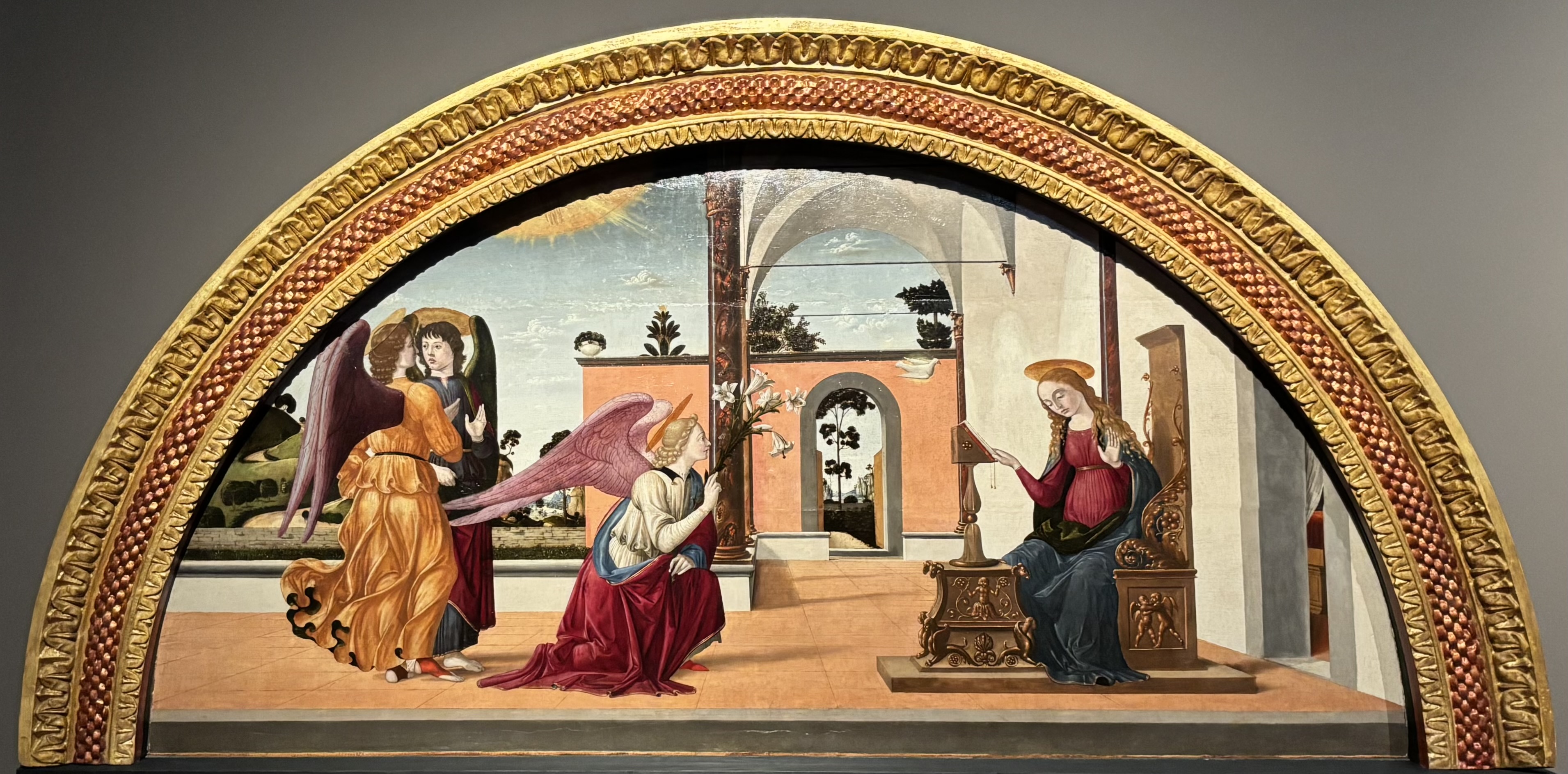
The painting depicts the Annunciation as narrated in the Gospel according to St. Luke (Lk 1:26-38).
Beneath a classicising loggia, the Virgin Mary, on the right, is reading a prayer book when her reading is interrupted by a visit from the Archangel Gabriel, shown kneeling in the centre of the composition. Bearing a bunch of lilies symbolising purity, he tells her that she will conceive and give birth to Jesus, the Son of God. Two angels, engaged in earnest conversation on the left, witness the miraculous event. Upper right, in a golden cloud, we see the hands of God the Father sending Mary a dove, an image of the Holy Ghost, to symbolise her conception of Christ. Beyond the low wall surrounding the neat garden, a hortus conclusus symbolising Mary’s unspoilt virginity, we can see an airy landscape with gentle hills and luxuriant vegetation.
The painting, which entered the Pinacoteca’s collections from the Palazzo del Seminario in Faenza in 1887, originally graced the church of San Pietro a Fossolo, which began life as an oratory dedicated to the Blessed Virgin Annunciate and was situated on land belonging to the Manfredi family. Two other paintings by Tucci, almost certainly coeval with the Annunciation and depicting St. Sebastian and St. John the Baptist, came from the same oratory. Entering the Pinacoteca at the same time as the Annunciation, they were stolen during World War II and have never been found since. The Annunciation’s format suggests that it must once have been the upper part of an altarpiece or polyptych. We cannot rule out the possibility that the two lost panels may also have been part of the same decorative complex. Nor, in the absence of documents, can we be certain that this decorative complex was originally made for the Oratory of the Virgin Annunciate, although that is highly likely to have been the case.
The latest scholarship (Bartoli 1999, Tambini 2009) has suggested dating the Pinacoteca di Faenza Annunciation c. 1475, although earlier scholars tended to favour a later date, c. 1480 (Buscaroli, 1931; Longhi, 1938; Corbara, 1947; Golfieri, 1964; Caglioti, 1995) or even c. 1483 (Angelini, 1986).
In stylistic terms, the Annunciation clearly reveals Florentine influence, the loggia of Mary’s house recalling the architecture of Brunelleschi and Michelozzo (Tambini, 2009), while the composition of the scene is reminiscent of some of the work of Domenico Veneziano, of Filippo Lippi and, above all, of Verrocchio. The style of Verrocchio and his workshop is also echoed in the construction of the figures’ drapery, and a further illustrious precedent for Tucci’s painting may also be found in Leonardo da Vinci’s Annunciation now in the Uffizi, which he seems to have imitated particularly in the pose of the Virgin’s right arm (Bartoli, 1999). The carved chair and lectern, on the other hand, appear to hark back to certain Florentine sculptures of the 1470s (Caglioti, 1995).
Tucci’s Annunciation is first mentioned in art historical literature in 1893, when Adolfo Venturi attributed it and the two lost saints to Giovanni Battista Utili, a 15th century painter from Faenza. This hypothetical attribution was accepted by scholars until Carlo Grigioni, writing in 1934 after meticulously studying the archive documents in Faenza, put forward the name of the Florentine painter Biagio d’Antonio Tucci who is recorded as having worked in Faenza in the second half of the 15th century. Grigioni’s suggestion instantly found favour with later scholars and was confirmed once and for all by the research conducted by Antonio Corbara in 1947.