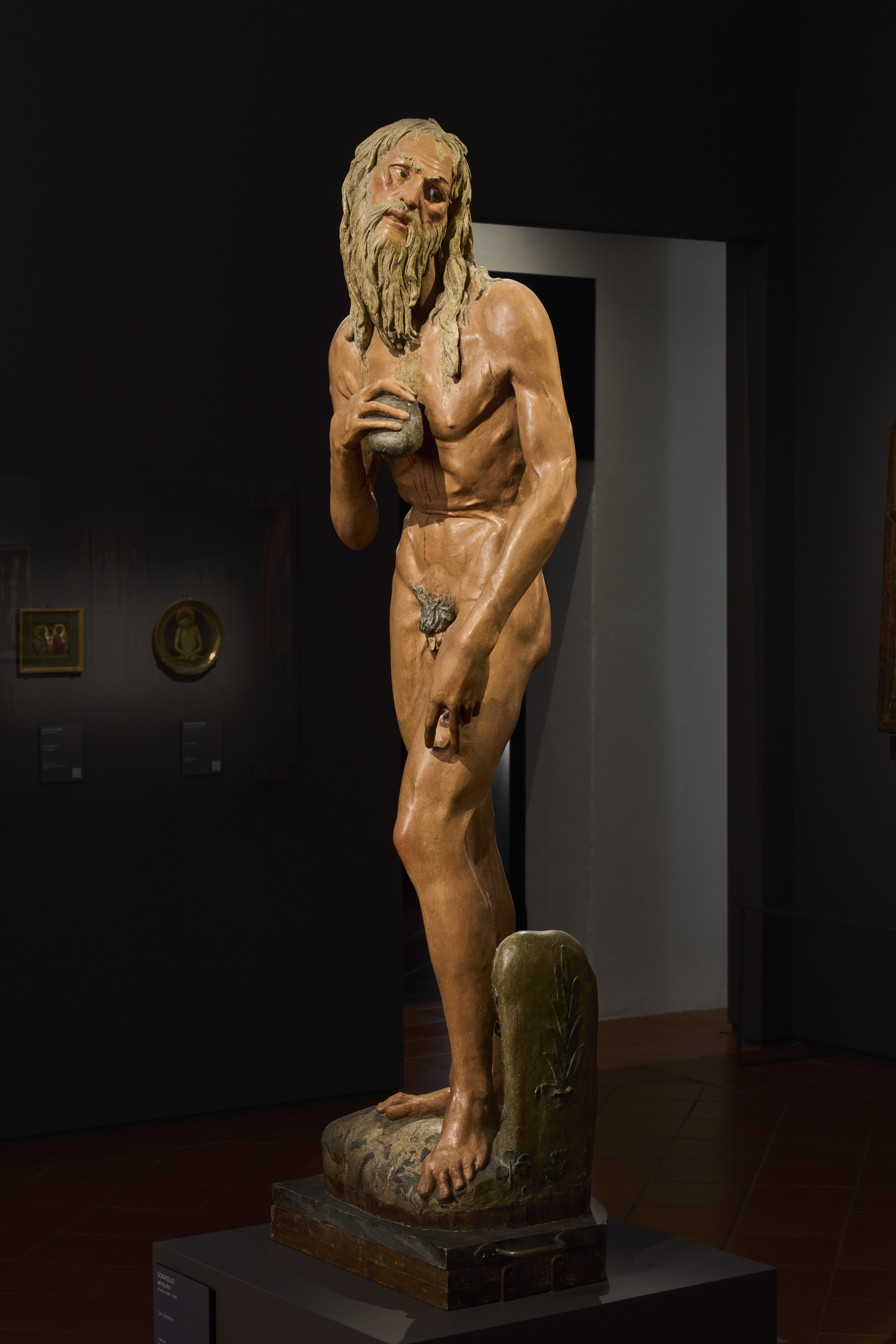
St. Jerome

_AP_6539

Donatello

date
c. 1460-1466
tecnique
painted wood
tow and plaste
dimensions
141 x 35 x 26 cm
source of the artwork

Faenza, church of San Girolamo degli Osservanti, Manfredi Chapel; entered the Pinacoteca in 1879 following the dissolution of the monasteries after the unification of Italy

short description

This sculpture, from the Manfredi Chapel in the church of San Girolamo degli Osservanti, depicts the saint at the time that he had withdrawn to the Syrian desert to live such a harsh life of fasting and atonement that he was even led to beating his breast with a stone until it bled. Scholars identified the sculpture some time ago as the St. Jerome “made of wood” which Giorgio Vasari tells us Donatello fashioned for Faenza, yet its autograph nature is still a topic of lively debate, with some scholars continuing to recognise Donatello’s hand in it, while others consider it to be the work of his pupil and assistant Bertoldo di Giovanni. Whatever the truth of the matter, the Faenza St. Jerome is indissolubly linked to the celebrated Penitent Magdalen that Donatello carved for the Baptistery of San Giovanni in Florence; indeed, so much so that it is perfectly plausible to argue that the two wooden sculptures are the product of a single creative mind.

inventary n°
168

St. Jerome, having shed his tunic, is portrayed beating his breast as he gazes towards an unspecified spot on his left. The iconography is that of the saint at the time that he had withdrawn to the desert to live a life of fasting, prayer and atonement in 375–6 AD. Scholars identified this masterpiece of Renaissance sculpture some time ago as the “St. Jerome made of wood” which Giorgio Vasari, the great art historian from Arezzo, tells us Donatello fashioned for Faenza, an identification further echoed in Sienese writer Ettore Nini’s guide to Faenza published in 1630, in which he describes “the wooden St. Jerome” as being “by Donatello” (Carabellese 2023). The importance of the sculpture for the local school of art is also borne out by a drawing by Sigismondo Foschi, a painter born in Faenza but trained in Florence, who portrayed the sculpture in a drawing formerly in the collection of Cardinal Leopoldo de’ Medici and now in the Gabinetto dei Disegni e delle Stampe degli Uffizi (Ng 2019). Yet the circumstances and chronology of the sculpture’s commissioning are still an object of scholarly debate. It is not clear whether it should be associated with the patronage of Astorgio II Manfredi or with that of his son Federico, who was bishop of Faenza from 1470 to 1478. This uncertainty also accounts for scholars’ differences of opinion over its attribution, given that Astorgio and Federico, despite living within a few years of one another, are separated by a crucial event: the death of Donatello in 1466. This date has sparked a lively debate between those who argue in favour of the sculpture being by the hand of Donatello, thus commissioned by Astorgio II, and those who claim that it was commissioned later, while Federico was bishop, and is thus by a different hand. A significant moment in the sculpture’s critical history was the 1968 exhibition entitled Donatello e i suoi, where the St. Jerome was shown with an entry by Bruce Boucher stating that it was by the hand of Donatello. Writing only a few years later, in 1992, however, James Draper (1992) included it in his monographic work on Bertoldo di Giovanni, “Donatello’s pupil, an expert bronzesmith, a master of sculpture and also a carver of wood” (Lucidi 2016). This hypothesis has attracted the support of such authoritative scholars as Gianluca Amato (2022), Alfredo Bellandi (2004-2005), Francesco Caglioti (2008a; 2008b; 2009-2010; 2019) and Massimo Ferretti (2011), who flesh out their attribution to Bertoldo by highlighting affinities between the St. Jerome and certain small bronzes definitively attributed to Bertoldo. Yet we cannot ignore the very strong bond linking the St. Jerome to the Penitent Magdalen which Donatello carved in wood for the Baptistery of San Giovanni in Florence. The two sculptures share a withered body whose emaciation is accentuated by the swollen veins pressing up from beneath a rubbery skin, and locks of thick, tangled hair surrounding skeletal faces marked by expressions of shock. Both figures are also characterised by an unstable, precarious pose, their feet resting on a rocky outcrop as though they might slip at any moment, a feature extremely typical of the figures that Donatello carved. The St. Jerome is thus highly likely to have been commissioned from the ageing sculptor in the final years of his career, when he was busy working on the bronze pulpits for the church of San Lorenzo. At that point in his career, Donatello was surrounded by his pupils – their number including Bertoldo di Giovanni – who may well have collaborated on the execution of the St. Jerome. What is certain, at any rate, is that behind the St. Jerome worn down by atonement there can only be the same mind that conceived the Magdalen in the Baptistery in Florence, namely Donatello.

Amato 2022
G. Amato. “Il ‘Giovane platonico’ di Bertoldo di Giovanni, ovvero il ‘Ritratto di Giovanni Cavalcanti, ‘amico unico’ di Marsilio Ficino”, Prospettiva 183, 2022, pp.16–67 (esp. pp. 37-49)

Bellandi 2004-2005
A. Bellandi. La scultura lignea del Rinascimento a Firenze: 1400-1520. PhD diss., University of Perugia, 2004-2005, pp. 140, 142

Boucher 1986
B. Boucher, in Donatello e i suoi. Scultura fiorentina del primo Rinascimento, exhibition catalogue (Florence, Forte di Belvedere, 15 June – 7 September 1986), ed. A. Phipps Darr and G. Bonsanti, Florence 1986, entry no. 56, pp. 172-174

Caglioti 2008a
F. Caglioti, “Il Crocifisso del Bosco ai Frati di fronte ai modelli di Donatello e Brunelleschi.” In Mugello culla del Rinascimento, Giotto, Beato Angelico, Donatello e i Medici, exhibition catalog, edited by B. Tosti (Vicchio di Mugello: Museo d’Arte Sacra e Religiosità Popolare Beato Angelico; San Piero a Sieve: Convento di San Bonaventura al Bosco ai Frati; Borgo San Lorenzo: Museo della Manifattura Chini; Scarperia: Palazzo dei Vicari; Florence: Palazzo Medici Riccardi, May 29 – November 30, 2008) pp. 125–163 (esp. pp. 156-160)

Caglioti 2008b
F. Caglioti, “Il ‘Crocifisso’ ligneo di Donatello per i Servi di Padova”, Prospettiva 130-131, 2008, pp. 50–106

Caglioti 2009-2010
F. Caglioti, “Donatello miracoloso. Il crocifisso ligneo dei Servi.” Atti e memorie dell’Accademia Galileiana di Scienze, Lettere ed Arti CXXII, 2009-2010, pp. 59–85 (esp. p. 85)

Caglioti 2019
F. Caglioti, Bertoldo’s place between Donatello and Michelangelo, in Bertoldo di Giovanni. The Renaissance of Sculpture in Medici Florence, exhibition catalogue (New York, The Frick Collection, 18 September 2019 – 12 January 2020), ed. A. Ng, A.J. Noelle, X.F. Salomon, New York 2019, pp. 81-108 (with bibliography)

Carabellese 2023
B. Carabellese, “Ettore Nini e un’inedita guida artistica di Faenza, con nuove notizie sul donatelliano S. Giovanni Battista ligneo”, Studi di Memofonte, 31, 2023, pp. 72-81

Draper 1992
J. Draper, Bertoldo di Giovanni. Sculptor of the Medici household, Columbia 1992, pp. 186-197

Ferretti 2011
M. Ferretti, Il San Girolamo “di legname”: Bertoldo di Giovanni, in Storia delle arti figurative a Faenza, vol. IV, La scultura del Quattrocento, Faenza 2011, pp. 96-110

Lucidi 2016
D. Lucidi, in “Fece di scoltura di legname e colorì”, scultura del Quattrocento in legno dipinto a Firenze, exhibition catalogue (Florence, Galleria degli Uffizi, 21 March 2016 – 27 August 2016), ed. A. Bellandi, Milan 2016, entry no. 3, pp. 166-167 (with bibliography)

Ng 2019
A.Ng, in Bertoldo di Giovanni. The Renaissance of Sculpture in Medici Florence, exhibition catalogue (New York, The Frick Collection, 18 September 2019 – 12 January 2020), ed. A. Ng, A.J. Noelle, X.F. Salomon, New York 2019, entry no. 18, pp. 417-423

Stiberc 2019
P. Stiberc, St. Jerome in the Pinacoteca Comunale in Faenza. A Carved and Modeled Sculpture, in Bertoldo di Giovanni. The Renaissance of Sculpture in Medici Florence, catalogo della mostra (New York, The Frick Collection, 18 settembre 2019 – 12 gennaio 2020), a cura di A. Ng, A.J. Noelle, X.F. Salomon, New York 2019, pp. 273- 289.

The images are the property of the Pinacoteca Comunale di Faenza. For the use of the images, please write to infopinacoteca@romagnafaentina.it.

written by
Beatrice Rosa