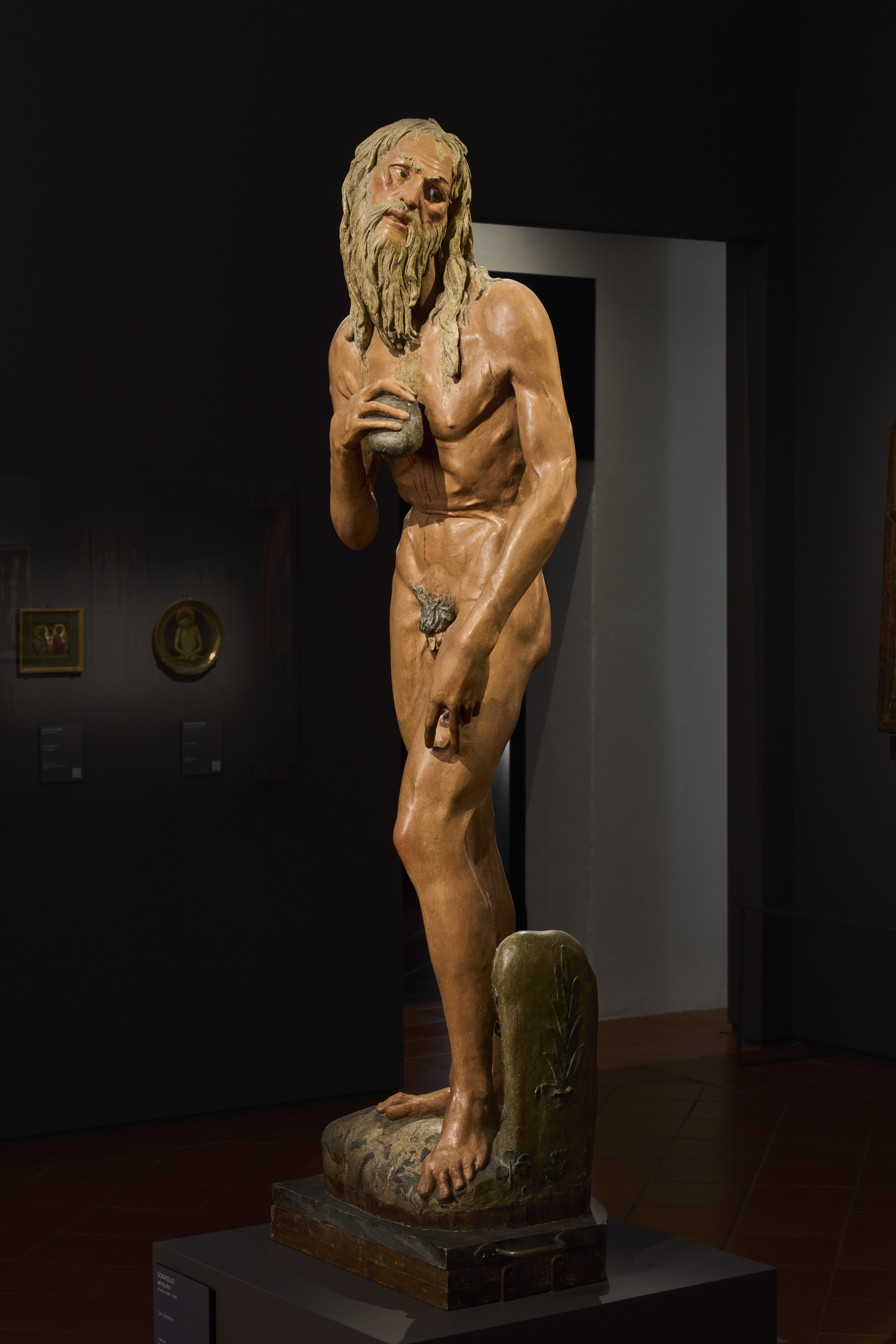
Donatello (Donato di Niccolò di Betto Bardi)
Donatello was born in Florence, probably in 1386, into a family living in the Oltrarno neighbourhood. His name is first mentioned in a document in the archives in Pistoia dated January 1401, in somewhat unusual circumstances, on a charge of injuring a certain “Anichino di Pietro” with a stick. In those same years, Filippo Brunelleschi (a man who was soon to play a role of the first importance in the young sculptor’s life) was working as a goldsmith on the large silver altar dedicated to St. James in Pistoia Cathedral. Yet despite the fact that Donatello may thus have frequented the future architect in those early years, the sources assign him only one master, namely Lorenzo Ghiberti, in whose workshop he is recorded between 1404 and 1407, in the early stages of work on the north door of the Baptistery of San Giovanni in Florence. This period of training is reflected in his earliest work, for example the Small Prophet on the left of the Porta della Mandorla (1406) and the Santa Croce Crucifix (c. 1408). In 1407, by which time he had left Ghiberti’s workshop, Donatello forged a partnership with Filippo Brunelleschi, a relationship that was fated to last some forty years. From that moment on, until about 1423, he focused on Florence’s cathedral, known as Santa Maria del Fiore, and on Orsanmichele. For the Fabbrica di Santa Maria del Fiore he carved, in the following order; a marble David (1408–9) initially intended to stand atop one of the cathedral buttresses; St. John the Evangelist for Arnolfo di Cambio’s façade (1408–15); and a series of five Prophets for the niches of Giotto’s Bell Tower (completed 1435–6). In parallel, for Orsanmichele, he carved St. Peter (c. 1410–12) for the niche of the Arte dei Beccai, St. Mark (c. 1411–13) for the niche of the Arte dei Linaioli e Rigattieri, and St. George (c. 1415–17) for the niche of the Arte dei Corazzai e Spadai, which he completed with a tabernacle and a predella, the latter in the shape of a bas-relief containing his first experiment with scientific perspective. This series of successes finally won him the commission for the building’s most important niche, that of the prestigious Parte Guelfa, in the centre of its east-facing façade, for which he fashioned the large bronze St. Louis of Toulouse (c. 1418–25) now in the refectory of the Basilica of Santa Croce.
Starting in 1424, Donatello embarked on a fruitful partnership with Michelozzo that was to last for almost fifteen years. Over that long period of time, the two artists worked together on such masterpieces as the tomb of Baldassare Coscia (c. 1422–8) in the Baptistery in Florence and that of Cardinal Rinaldo Brancaccio (c. 1426–8) in Sant’Angelo a Nilo in Naples, as well as on the astonishing Pulpit of the Holy Girdle in Prato (1428–38). In those same years, Donatello also became involved in the project for the Baptismal Font in Siena, delivering his celebrated gilt bronze relief depicting the Banquet of Herod in 1427. His reputation spread rapidly throughout Italy, leading to invitations and commissions from Orvieto, Siena, Naples, Prato and Rome. He spent a year in the papal capital in 1432–3, producing the tabernacle of the Sacrament and the gravestone of Archdeacon Giovanni Crivelli while there. On his return to Florence, he won further prestigious commissions, including the Cantoria or choir loft for the Cathedral (1433–9) and the decoration of the Old Sacristy in San Lorenzo (1435–40) for the Medici family, who were also responsible for commissioning a bronze David (1435–40) from him in those years.
Until his return from Rome in 1433, Donatello had chiefly been called on to work on public commissions, but from that year on he began to focus increasingly on commissions from private patrons. This meant that the Opera del Duomo lost its role as the sculptor’s most important patron, and he began to prioritise work for such aristocratic Florentine families as the Cavalcanti, the Martelli, the Bartolini Salimbeni and, above all, the Medici. It was in this context that he produced such masterpieces as the Cavalcanti Annunciation in the Basilica of Santa Croce (c. 1433–5), St. John the Baptist for Casa Martelli (c. 1442), the wonderful marble reliefs with the Ascension with Christ Giving the Keys to St. Peter (c. 1425) and the Feast of Herod (c. 1435) for the Medici, not to mention the bronze Amore-Attis for the Bartolini-Salimbeni (c. 1435–5)
The year 1443 marked the beginning of a new chapter in Donatello’s career when he moved to Padua, where he was to spend the next ten years. While there, he produced such pivotal masterpieces as the Equestrian Statue of Gattamelata (1445 – c. 1453) and the High Altar of St. Anthony (1446–5), which had an extraordinary impact on the development of art not just in the city but in a large part of northern Italy as well. On his return to Tuscany, Donatello was overwhelmed with new commissions. In 1457, now an old man, he moved almost surreptitiously to Siena, taking with him the bronze St. John the Baptist (c. 1455–7; 1465) now in Siena Cathedral, and leaving a Judith for the Medici family’s garden unfinished. Yet the move failed to mark a break with the Medici. In fact their relationship continued to flourish even at a distance, before firming up for good on his return to Florence in 1461. On his return to the city, Donatello devoted his energy with boundless enthusiasm to his work for the Medici. The Judith was completed and unveiled (1457–64), and Cosimo de’ Medici commissioned two monumental bronze pulpits from him for the church of San Lorenzo (c. 1461–6). Though designed in their entirety by Donatello himself, the pulpits’ execution was largely entrusted to his pupils, who completed the work after their master’s death on 13 December 1466 (see F. Caglioti, Vita di Donatello, in Donatello. Il Rinascimento, exhibition catalogue (Florence, Palazzo Strozzi, 19 March – 31 July 2022), ed. F. Caglioti with L. Cavazzini, A. Galli, N. Rowley, Venice 2022, pp. 25 – 105).
Beatrice Rosa